
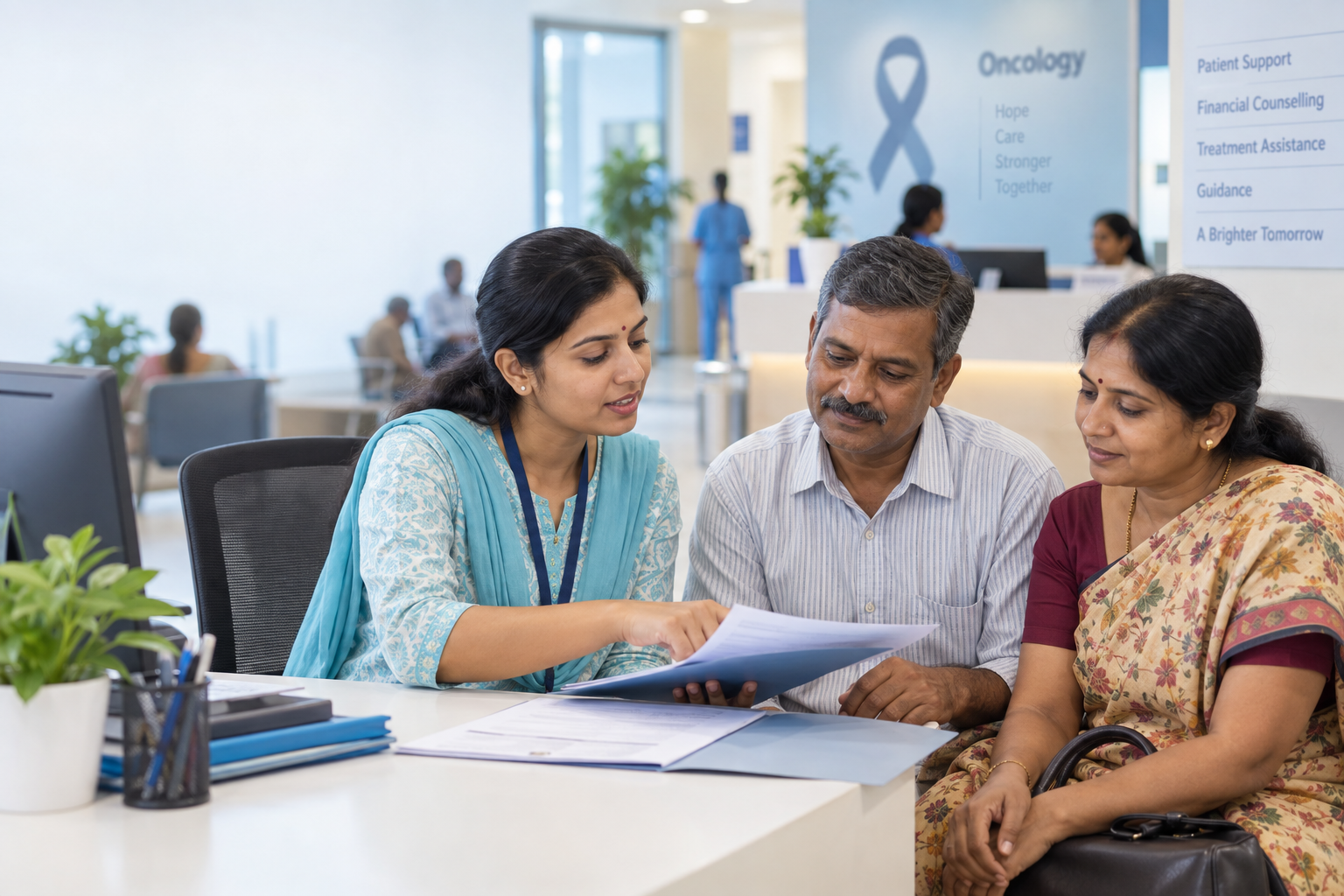
A cancer diagnosis is frightening enough without the added fear of how to pay for treatment. Yet across Andhra Pradesh and Telangana, most cancer care — surgery, chemotherapy and radiation — can be received completely free through government health schemes. The difficulty is rarely eligibility; it is knowing which scheme applies to you, which hospital to walk into, and what paperwork to carry. This step-by-step guide explains exactly how to access free cancer treatment through PM-JAY, Rajiv Aarogyasri and Dr. NTR Vaidya Seva.
If you would rather have someone walk you through it, the team at Dhanvantari Cancer Foundation assesses every case free of charge — call or WhatsApp +91 82470 94634, Monday to Saturday, 8 AM to 8 PM.
The three schemes that fund cancer treatment
Three schemes cover cancer treatment in our region, and they often work together rather than separately. Knowing what each one offers is the first step to getting the most support you are entitled to.
1. PM-JAY (Ayushman Bharat) — the central scheme
Ayushman Bharat Pradhan Mantri Jan Arogya Yojana provides cashless cover of up to ₹5 lakh per family per year at empanelled hospitals nationwide, and covers a wide range of cancer surgeries, chemotherapy and radiotherapy. Eligibility is based on the national beneficiary list. You can check details on the official PM-JAY portal.
2. Rajiv Aarogyasri — Telangana's scheme
Telangana's flagship scheme, administered by the Aarogyasri Health Care Trust, covers up to ₹10 lakh per family per year after the 2024 enhancement, and is integrated with PM-JAY. Families holding a white ration card are generally eligible, and cancer surgery, chemotherapy and radiotherapy are all included. You can verify your status on the official Telangana Aarogyasri portal.
3. Dr. NTR Vaidya Seva — Andhra Pradesh's scheme
Andhra Pradesh's equivalent (earlier known as YSR Aarogyasri) now offers up to ₹25 lakh per family per year across thousands of listed procedures, again linked to the white ration card and income and asset limits. Details are on the official Dr. NTR Vaidya Seva portal.
Because covered-procedure lists and eligibility rules are revised from time to time, the safest step is to have your specific case checked before choosing a hospital. Our financial aid team does exactly this, at no cost.
Are you eligible?
For the two state schemes, eligibility usually rests on three things:
- A white / food-security ration card — or a listing in the state's BPL database.
- Residency in Telangana or Andhra Pradesh.
- Income and asset limits — for example, in Andhra Pradesh, household income below ₹5 lakh a year and landholding within the prescribed limit.
For PM-JAY, eligibility follows the national beneficiary list rather than the ration card. Many families qualify for more than one scheme — which is a good thing, because coverage can be combined for a longer or costlier course of treatment. If you are unsure where you stand, we will check every scheme for you.
Documents you'll need
Keep originals and photocopies together in one folder from day one — it saves days of running around later. Most patients are asked for:
- White ration card / food-security card
- Aadhaar card (patient, and often a family member)
- Biopsy or pathology report confirming the cancer diagnosis
- Doctor's referral or diagnosis certificate
- Recent scans and treatment notes
- Passport-size photographs
Step by step: how to get cashless cancer treatment
- Confirm the diagnosis in writing. You need biopsy or pathology reports — not just a doctor's verbal opinion — before any scheme claim can be raised.
- Choose an empanelled hospital. Only hospitals on the scheme's approved list can offer cashless treatment. Starting at a non-empanelled hospital is the most common — and most expensive — mistake. Empanelled cancer centres operate in Hyderabad, Warangal and Nizamabad, and across Vijayawada, Visakhapatnam, Guntur and Tirupati.
- Meet the Aarogya Mithra / Vaidya Mitra desk. Every empanelled hospital has this help desk. Staff verify your eligibility on the spot and open your case.
- Complete pre-authorisation. The hospital submits your treatment plan to the Trust for approval. This is where most errors and delays happen — and where expert help matters most.
- Begin cashless treatment. Once approved, covered treatment proceeds without any upfront payment.
- Track your follow-up cycles. Chemotherapy and radiation run over weeks or months; keep every approval and discharge summary safe for the next cycle.
Importantly, white ration card holders usually do not need to register online in advance — you can walk into an empanelled hospital with your ration card and Aadhaar, and the Aarogya Mithra desk handles verification. A family member or caregiver can complete most of this on the patient's behalf, which matters when the patient is unwell or elderly.
How long does approval usually take?
Timelines vary by hospital and by how complete your file is, but for planned treatment, pre-authorisation is often approved within a few working days once the paperwork is in order. Genuine emergencies are fast-tracked, and many empanelled hospitals begin urgent care while the approval is being processed. The single biggest cause of delay is rarely the Trust — it is missing or mismatched documents at the patient's end, which is exactly why having your file checked before submission is worth the effort. If an approval seems stuck, the hospital's Aarogya Mithra desk can tell you what is pending, and our social workers can follow up with the Trust on your behalf so treatment is not held up.
Common mistakes that delay or reject claims
- Starting treatment at a non-empanelled hospital, then trying to transfer the claim.
- Incomplete or mismatched documents — a name spelled differently on Aadhaar and the ration card can stall a file for days.
- Skipping the pre-authorisation step and paying out of pocket, then struggling to get reimbursed.
- Giving up midway when a claim is queried, instead of correcting and resubmitting.
Every one of these is avoidable with the right guidance from someone who handles these applications every day.
What if the scheme doesn't cover everything?
Sometimes a scheme's annual limit is reached, or a specific medicine or procedure sits outside the approved package. This is where a non-profit can bridge the gap. Dhanvantari's own patient fund and corporate CSR grants provide additional support — typically ₹10,000 to ₹75,000 — so treatment need not stop for want of funds. You can see the full range of help on our services page.
How Dhanvantari Cancer Foundation helps — free of charge
Many families abandon treatment simply because the paperwork feels overwhelming, or a claim is rejected on a technicality. Our social workers assess your case at no cost, tell you which scheme you qualify for, help you gather documents, and follow the pre-authorisation through to approval — in Telugu, Hindi or English. Where a scheme falls short, we help close the gap through our own fund and donor grants.
We are a registered, 80G-certified non-profit. You can read more about us, or contact our team any day, Monday to Saturday, 8 AM to 8 PM.
Early detection also keeps treatment simpler and more affordable. If you or a family member has noticed warning signs, our free screening camps are open for registration across the region.
Don't let cost stop your treatment
No family should have to choose between treatment and survival. If you or someone you love has been diagnosed with cancer in Andhra Pradesh or Telangana, reach out today — apply for financial aid, or call +91 82470 94634. And if you would like to help other patients reach this support, you can also donate — every contribution funds free treatment guidance for a family in need.